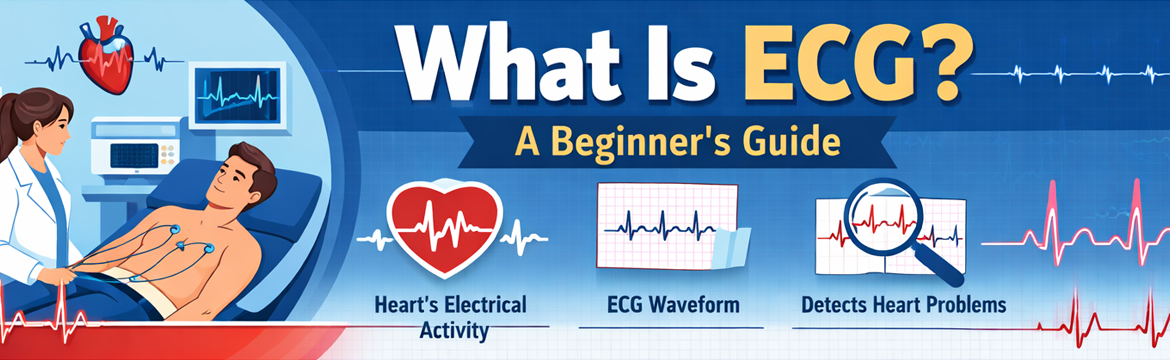
How to Read ECG Step by Step (Beginner to Clinical Guide)
Reading an ECG can feel overwhelming at first.
So many lines… so many waves…
But here’s the truth:
If you follow a simple step-by-step system, ECG becomes easy.
Why You Need a System
Most beginners make this mistake:
Looking at the ECG randomly
Trying to guess the diagnosis
That leads to confusion.
Instead, always follow a structured approach.
The 7-Step ECG Interpretation Method
Use this exact order every time:
1️.Check Patient Details & Calibration
Before anything:
- Name, age, clinical context
- Paper speed: 25 mm/sec
- Calibration: 10 mm = 1 mV
Mistakes here = wrong interpretation.
2️.Calculate Heart Rate
Quick methods:
- 300 ÷ number of large squares between R waves
- Or count beats in 10 seconds × 6
Normal: 60–100 bpm
3️.Check Rhythm
Ask:
- Is it regular or irregular?
- Is there a P wave before every QRS?
If yes → likely sinus rhythm
4️.Look at the P Wave
- Present or absent?
- Normal shape?
Abnormal P waves may indicate:
- Atrial enlargement
- Atrial fibrillation (no clear P waves)
5️.Measure Intervals
Key intervals:
- PR interval: 120–200 ms
- QRS duration: < 120 ms
- QT interval: varies with heart rate
These help detect conduction problems.
6️.Analyze the QRS Complex
Check:
- Width (narrow or wide?)
- Shape (normal or abnormal?)
Wide QRS may indicate:
- Bundle branch block
- Ventricular rhythm
7️.Look for ST & T Wave Changes
This is critical for detecting ischemia.
- ST elevation → possible myocardial infarction
- ST depression → ischemia
- T wave inversion → abnormal repolarization
Simple ECG Checklist (Save This)
Every ECG → Ask:
- Rate?
- Rhythm?
- P waves?
- PR interval?
- QRS width?
- ST changes?
- T waves?
This checklist = your ECG survival tool
Clinical Example
- Irregular rhythm + no P waves
Think: Atrial Fibrillation - ST elevation in inferior leads
Think: Inferior MI
Clinical Insight (High Value)
The biggest difference between beginners and experts:
Experts don’t guess—they follow a system.
Even in emergency situations, doctors rely on:
Structured interpretation
Pattern recognition
How to Improve Fast
To master ECG:
- Practice daily (5–10 ECGs)
- Compare normal vs abnormal
- Focus on patterns, not memorization
Repetition builds confidence.
Want to Read ECG Like a Pro?
This guide is just the beginning.
If you want to:
- Interpret ECG confidently
- Diagnose real clinical cases
- Master ECG step-by-step
Join the Full ECG training at CardiologyMaster.com
References
Use these trusted sources for your article:
- Goldberger's Clinical Electrocardiography
- Braunwald's Heart Disease
- American Heart Association
(ECG interpretation standards and basics) - Life in the Fast Lane
(Excellent step-by-step ECG interpretation guides) - Mayo Clinic
(Beginner-friendly ECG explanations)
.png)
.webp)
.webp)