
Normal ECG Values and Intervals (Complete Beginner Guide)
If you want to read ECG correctly, you must first know what’s normal.
Because:
You can’t recognize abnormal… unless you understand normal.
Why Normal ECG Values Matter
Every ECG interpretation starts with one question:
“Is this normal or abnormal?”
To answer that, you need to know:
- Normal timing
- Normal wave shapes
- Normal intervals
The Key ECG Components You Must Know
An ECG consists of:
- P wave → Atrial contraction
- QRS complex → Ventricular contraction
- T wave → Ventricular recovery
Between these waves, we measure intervals.
Normal ECG Intervals (Core Values)
Here are the most important numbers:
- PR Interval
- Normal: 120 – 200 ms
- Represents: Time from atria → ventricles
Clinical Meaning:
- Prolonged PR → AV block
- Short PR → Pre-excitation (e.g., WPW)
- QRS Duration
- Normal: < 120 ms
- Represents: Ventricular depolarization
Clinical Meaning:
- Wide QRS → Bundle branch block or ventricular origin
- QT Interval
- Normal (corrected QTc):
- Men: < 440 ms
- Women: < 460 ms
Clinical Meaning:
- Prolonged QT → Risk of dangerous arrhythmias
- Short QT → Less common but abnormal
- Heart Rate
- Normal: 60 – 100 beats per minute
Clinical Meaning:
- < 60 → Bradycardia
- 100 → Tachycardia
- P Wave Duration
- Normal: < 120 ms
Clinical Meaning:
- Tall P wave → Right atrial enlargement
- Wide P wave → Left atrial enlargement
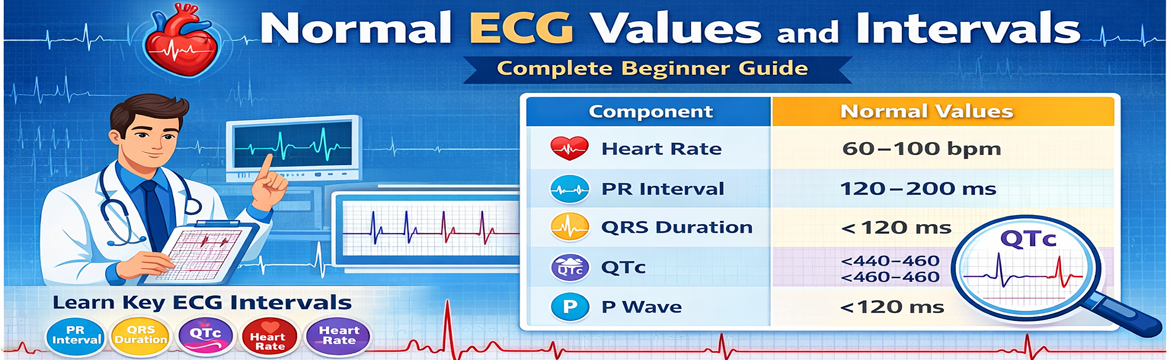
Quick ECG Normal Values Table
|
Component |
Normal Value |
|
Heart Rate |
60–100 bpm |
|
PR Interval |
120–200 ms |
|
QRS Duration |
< 120 ms |
|
QTc |
< 440–460 ms |
|
P Wave |
< 120 ms |
Save this table—it’s essential.
Clinical Examples
- PR interval = 240 ms
Think: First-degree AV block - QRS = 160 ms
Think: Bundle branch block - QT prolonged
Risk: Torsades de Pointes
Clinical Insight (High Value)
One of the most common beginner mistakes:
Memorizing numbers without understanding meaning
Always connect values to:
- Physiology
- Clinical conditions
That’s how ECG becomes powerful.
Pro Tip (Very Important)
Don’t try to memorize everything at once.
Start with:
- PR interval
- QRS width
- Heart rate
Then build gradually.
How to Master ECG Intervals
To improve fast:
- Practice measuring on real ECGs
- Compare normal vs abnormal
- Repeat daily
ECG is a skill—not just knowledge
Want to Master ECG Like a Pro?
This is just the foundation.
If you want to:
- Interpret ECG confidently
- Detect abnormalities instantly
- Think clinically
Join the full ECG program at CardiologyMaster.com
References
Use these trusted sources for your article:
- Goldberger's Clinical Electrocardiography
- Braunwald's Heart Disease
- American Heart Association
(Standard ECG interpretation values and guidelines) - Life in the Fast Lane
(Excellent ECG interval explanations) - Mayo Clinic
(Beginner-friendly ECG resources)

.png)
.webp)
.webp)